“Grandma where were you? I didn’t know where you were!”
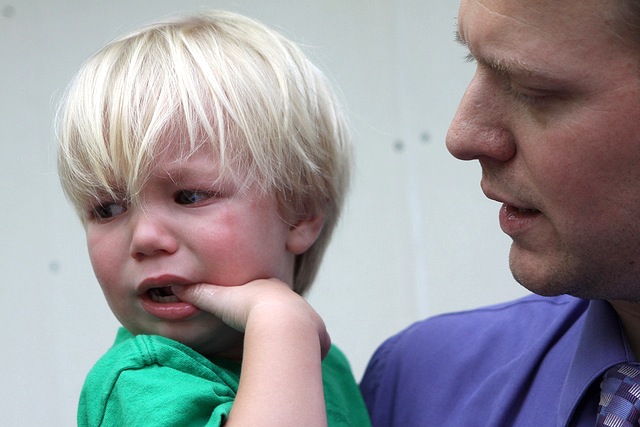
I heard these words from a tear stained little four-year-old boy running towards his grandma as she stepped out of the bathroom yesterday at Mountain Baby.
“I just went to the bathroom, Sweetheart”, his Grandma said as she hugged him. “I told you. Did you forget?’
The little boy shook his head “Yes”, and held onto her tightly. He had been happily playing at the train table when she told him.
He was so absorbed in his play, he probably didn’t hear her. Then when he looked up to find her, she was gone.
He was suddenly alone. He was suddenly separated from someone he knew and loved.
He was suddenly terror-stricken.
I see this scenario frequently in the store….
Parents get busy shopping, kids get busy playing, and suddenly they are at opposite
ends of the store. Then, when they realize that they are out of view of each other, panic sets
in.
Children panic because the think they have been abandoned. This is the scariest feeling
that children experience.
For the child, the emotional response is primal, automatic, and intense.
This is an experience of “Separation Anxiety”.
Separation Anxiety refers to the intense distress experienced by babies and young children
when their parents or other loving caregiver leaves them or gets ready to leave them.
For children, it’s a normal developmental process. You see it most intensely when babies
are between 7 and 18 months,
Here’s what you may see:
• Your baby who would happily be passed around to friends and family suddenly gets very
distressed if they’re not in your arms.
• Your baby who previously smiled at anyone who smiled at them, suddenly gets very serious
and will stare suspiciously at strangers – or will deliberately turn away.
• When your baby does interact with others, they are constantly checking in with you to
make sure you are still there.
• Your toddler will not let you out of their sight. “I can’t even go to the bathroom alone” is
a frequent complaint of parents at this stage.
• Your toddler, who happily stayed with your neighbour for a short while, screams when you
go to leave.
• Saying goodbye at daycare suddenly becomes very difficult
• Some people refer to this stage as “the velcro age”.
This can be a very challenging time for you and your little one.
Many parents feel embarrassed by their child’s new clinginess. You may be criticized by
friends or family members for having raised a “momma’s boy” or “momma’s girl”.
And you know what?
You did.
And you know what else?
It’s a sign of real healthy emotional development.
It means that you have built a strong connection and attachment with your baby which
is the foundation for solid mental health.
When babies are born, they have no concept of themselves as a ‘self”. They don’t know that
they have hands, or feet, or where they end and you begin.
You and they are basically one.
As they mature, during the second half of the first year, they begin to realize that you
are a separate being…and that you can leave… and that they can suddenly be alone.
Cognitively, they don’t have the capacity to think ahead and know for sure that you will
return.
It takes time and experience for them to learn that, when you go, you come back.
They need to develop what is called “Object Permanence”. They need to realize that
things continue to exist even if they can’t see them.
Until they realize that, each time you leave can be very scary. Waking in the middle of
the night, alone, can be even scarier.
There are, of course, huge individual differences in how babies and toddlers handle separations.
Some children can breeze through this period with hardly a whimper, and still be well
attached.
Some babies and toddlers have a very difficult time with it. They have a very strong reaction
to your leaving and the stage may last longer for them.
The important thing to know is that you can’t argue or force a child out of separation
anxiety.
But, you can respect it and work with your child and their caregivers to ease the intensity.
Here are some ideas on how to do just that:
• If you don’t have to leave your child (for work or school ) when they are intensely in this
stage, minimize separations as much as possible.
• Some parents choose, if they can, to go back to work or school part time instead of full
time.
• Be sure your child is left with people who love them and will respond to their needs. Choose your child care with great care.
• If your child is going to daycare, visit together many times before you actually leave them
there on their own.
• If you are breastfeeding, feed your baby or toddler at the place they will be left and feed
them there as soon as you return.
• Stay for a while and play with them.
• Never sneak away. Always say goodbye and tell them you will be back.
• Make it very clear that you are to be called if they are very distressed and inconsolable.
• Some children really truly cannot handle separations at this stage. I’ve known many
parents who backed off on their work or school plans until their children were a little older.
• If you are able to be home with your child and they get very upset even when you leave
the room, pop them in a carrier and take them with you.
As children mature they gradually outgrow separation anxiety.
But it can resurface at any time:
• When you are in a strange place.
• When they start preschool or daycare or kindergarten.
• When you’ve been through a lot of changes – moving, vacationing, lots of visitors, family
stress, a new baby etc.
• When you are away from home and you suddenly can’t see each other (just as it happened
with the little boy in the store).
If you think about it, separation anxiety actually goes both ways. If you are out with your child
and suddenly can’t see them, you may well instantly go into total panic mode.
Or if you have to leave your child and they are wailing with grief at your leave-taking,
you may feel anxious and ill at ease until you hear that they are okay or you see them again.
Maybe this isn’t a developmental stage for you, but it’s intense and primal as well. We
are wired to be attached and connected to our children.
Remember that separation anxiety is a primal, fear-based response to perceived danger
of abandonment.
It is not manipulative. Responding to it with love and sensitivity is the best way to help
your child get through it.
The firmer the foundation of connection between our children and us, the healthier the drive towards independence will be when our children’s developmental readiness is honoured.
Just as children learn to feel safe moving out into the world and being without you for
longer and longer times as they grow up, you too will learn to let them ‘find their wings” as
confident, secure little people, and eventually, grownups.
You will never ever totally let go, though, because, as beautifully said by Elizabeth Stone:
Making the decision to have a child is momentous. It is to decide forever to have your heart
go walking around outside your body. -Elizabeth Stone
And as the parent of two grown children, I can most certainly vouch for the truth of that statement.